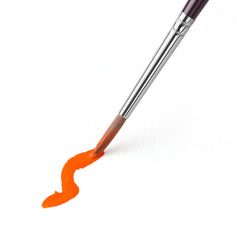
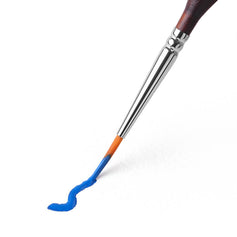

Nothing ruins a beautiful sculpt faster than a grainy, thick, or streaky paint job. Whether you are a beginner or looking to level up your display pieces, understanding why brush marks (or "stroke marks") occur is the first step toward achieving that professional, airbrushed look with a traditional brush.
In the world of miniature painting, the quality of the paint job directly determines the final look of the work. The video showcases the vast visual gap between incorrect and correct painting methods through a sharp contrast.
Why Does My Paint Look Streaky or Grainy
Identifyling the root cause of texture is essential for improving your technique. Here are the primary culprits:
Painting Over Semi-Wet Paint: This is the most common mistake. When you apply a second layer before the first is fully dry, you tear the "skin" of the drying paint, causing it to clump and deform.
Improper Paint Consistency: Using paint straight from the pot or using old, thickened pigments leads to heavy texture.
Subpar Tools: Brushes with splayed or split tips cannot distribute pigment evenly.
Excessive Pressure: Pressing too hard with your brush can physically "plow" the paint on the surface, leaving visible ruts.
Professional Techniques to Prevent Brush Marks
Prevention is always better than a cure. Use these industry-standard methods to ensure a flat, even coat.
Control Your Layers and Drying Time
The "One-Pass" Rule: Once you lay down a stroke, do not go back over it while it is wet.
Patience is Key: Allow each layer to dry for at least 2 hours. If you are in a rush, a hairdryer on a low-heat setting can speed up the process.
Multiple Thin Coats: It is better to have an uneven first coat than a think one. Smoothness comes from building up coverage over several passes.
Master Your Paint Consistency
Thinning & Leveling: Always dilute your paint on a wet palette. For an even better finish, use a slow-dry thinner (retader). This slows the drying time, allowing the paint to "self-level" and flatten out naturally before it sets.
The "Glazing" Approach: The most recommended method for a perfect finish is to dilute your paint until it is neary transparent. By applying dozens (or even hundreds) of ultra-thin layers, you eliminate brush marks entirely.
Optimize Your Tools and Motion
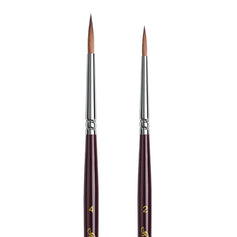
Invest in Quality: Use Kolinsky Sable brushes. High-quality sable hair retains its point (snap) and holds moisture better, preventing the bristles from splitting during application.
The Cross-Hatch Technique: To ensure even coverage, apply your first layer using vertical strokes (top to bottom). Once dry, apply the next layer using horizontal strokes (left to right). This "cross-hatching" helps cancel out visible lines.
How to Fix Brush Marks (Damage Control)
If you notice a mistake, your reaction depends on whether the paint is still wet or already cured.
If the Paint is Still Wet
- Normal Flow: If the paint looks slightly uneven but is the correct consistency, leave it alone; it often level out as it dries.
- Excess Paint: If there is a "blob" or pool of paint, quickly clean your brush, dampen it with clean water, and use it like a sponge to wick away the excess. You may need to repeat this several times to smooth the area.
If the Paint is Already Dry
- Mechanical Leveling: Once the paint has hardened and left a visible ridge, the only solution is to use fine-grit sandpaper to carefully sand the surface flat. After sanding, you must apply a fresh, thin coat of paint to restore the color.
Summary Table: Smooth Finish Checklist
| Problem | Solution |
| Visible Ridges | Use the Cross-Hatch method or sand down if dry. |
| Grainy Texture | Thin your paint with water or a retarder. |
| Clumping Paint | Wait at least 2 hours between coats. |
| Split Strokes | Switch to a Kolinsky Sable brush. |
Conclusion
In the pursuit of perfect miniature painting, eliminating brush marks is more than just a technique—it’s an ultimate sign of respect for detail. By mastering the correct paint consistency, choosing top-tier tools, and maintaining sufficient patience, you can completely move past a cheap "plastic" look and give every piece a silky, professional finish that rivals a work of art.